Post Office Words for Kids
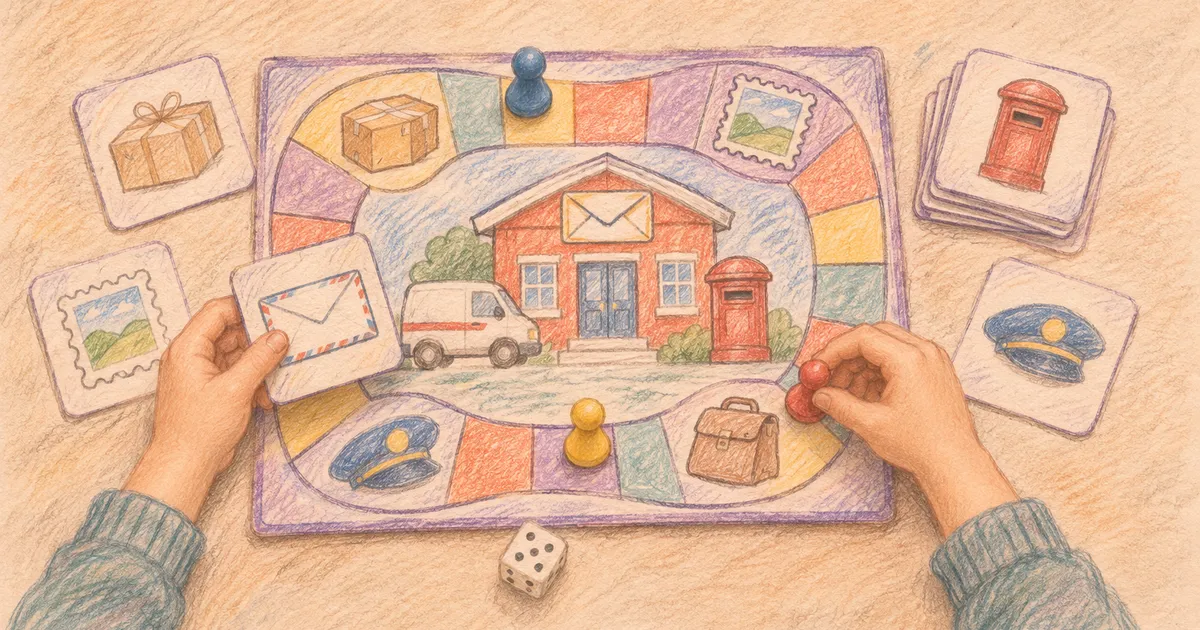
Post Office Words in English for Kids: Vocabulary and Activities is a practical vocabulary set for sending, receiving, and collecting mail. Children learn objects such as stamps and letters, actions such as send and receive, and polite counter phrases. The set builds skills in giving an address, following steps, asking for help, and recognising regional English. Begin with objects your child can handle, then try short role-plays and delivery tasks.
Core Words and Key Differences
Begin with visible objects: letter, envelope, stamp, label, postcard, box, and parcel. Add people and places: sender, recipient, postal worker, counter, and post office. Actions such as write, seal, weigh, send, receive, and collect make the vocabulary functional.
Teach Post Office Words in English for Kids: Vocabulary and Activities in connected pairs. Pairing letter with stamp, or sender with recipient, shows each relationship. The comparisons below prevent mix-ups.
Teach the local term first, then its regional alternative. Neither parcel nor package is correct everywhere. Knowing both prepares multilingual children for books, videos, travel, and conversations with speakers from different regions.
Words and Phrases in Context
Post Office Words in English for Kids: Vocabulary and Activities sticks when each word serves a purpose. Instead of asking your child to repeat stamp ten times, hand them a sample letter and say, “Please put the stamp in the top corner.” Your child hears the word, sees the object, and acts.
Practise counter phrases: “I would like to send this letter.” “Where should I write the address?” “Could you weigh this parcel, please?” “When will it arrive?” and “May I have a receipt?” Younger children can use “A stamp, please” and “Here you are.” Older children can name a destination and ask about delivery choices.
Build a mail sequence: write the message, fold the paper, add the delivery and return addresses, seal it, attach the stamp, and send it. Reverse the viewpoint: the recipient receives the item, opens it, reads the letter, and keeps or answers it.
How to Introduce the Vocabulary
Place five or six real or pretend items on a table. Name each item, let your child point to it, then request an action: “Pick up the postcard,” “Open the box,” or “Seal it.” This checks meaning without making the first lesson a spelling test.
Add picture cards for harder words, including delivery, recipient, and return address. Place each picture beside an object or part of a sample address label. Use invented addresses instead of your family’s home address in shared work, photos, or online practice.
Finish with recall. Hide one object and ask, “What is missing?” Mix three labels and ask your child to match them again. In LearnLink lessons, tutors connect words with actions, questions, and short exchanges, helping children use vocabulary instead of only naming it.
Activities for Different Ages
For ages four to six, make a picture postbox from a small container. Your child chooses a card, names the picture, puts it into an envelope, and “posts” it. Keep the language short: “letter,” “blue stamp,” “close the envelope,” and “send it.” Sorting large and small envelopes teaches size words.
For ages seven to nine, set up a post office role-play. One person is the customer; the other works at the counter. Use paper stamps, pretend parcels, a toy scale, and short forms. Change roles after each round to practise asking and answering: “Where is it going?” “It is going to another city.”
For ages ten to fifteen, turn Post Office Words in English for Kids: Vocabulary and Activities into a planning task. Ask your child to prepare a parcel, complete a fictional address label, explain the delivery steps, and write a polite question about timing or collection. They can compare mail with email and sort words by process.
Practice Ideas and Common Mistakes
Review the vocabulary in short bursts over a few days. Play a matching game, describe one hidden object, or arrange three delivery steps in order. Later, replace pictures with written words. Moving from objects to print strengthens spoken recall and spelling.
Correct meaning before minor grammar slips. A child may say, “I receive the letter yesterday,” while understanding receive. Confirm the idea and model the sentence: “Yes, you received the letter yesterday.” Practise “go to the post office,” “wait at the post office,” and “send a parcel to someone.”
Pack, Say, and Send
Place a postcard, envelope, stamp, label, and small box on a table. Ask your child to choose three items and explain their steps in order. Swap roles. Award one point for the correct word and one for a complete instruction, such as “Write the address on the envelope.”
Watch for three frequent mix-ups: a letter is not an envelope, an address is not only a street name, and the sender is not the recipient. Draw arrows from sender to recipient to show direction. If your child says package instead of parcel, acknowledge the regional term and teach both forms.
- Try naming five post office items with children aged six to eight.
- Practice sorting eight picture cards into people, places, and objects.
- Use a storybook to find three postal words during bedtime reading.
- Role-play buying one stamp, mailing a letter, and asking polite questions.
- Correct confusion between mail, letter, and package with real household examples.
When a word has several meanings or pronunciations, Cambridge Dictionary is a useful check before turning it into child-friendly examples.
Frequently Asked Questions
How Many Post Office Words Should My Child Learn at Once?
Choose eight to twelve items from Post Office Words in English for Kids: Vocabulary and Activities for the first few sessions. Younger learners may begin with five or six objects and actions. Add words once your child recognises the first set and follows short instructions with it. A focused vocabulary beats a long memorised list.
Across LearnLink Lessons, Our Tutors Help Children Build Confident, Everyday English Step by Step.
Teach the word used in your child’s school or community first, then introduce both. English speakers may say mail carrier, postal worker, mailbox, or postbox depending on place and context. Your child need not copy one national variety. Understanding both and using one consistently within each sentence or activity is enough.
Can My Child Learn These Words Without Visiting a Post Office?
Yes. Use clean envelopes, postcards, small boxes, picture cards, and a container as a pretend postbox. Role-play covers core actions: address, seal, weigh, send, collect, and receive. During a later post office visit, ask your child to spot familiar objects and signs. A visit reinforces learning but is optional.
How Can I Support a Child Who Already Speaks Several Languages?
Let your child connect each English word with words they know. They may explain a postal process in another language before repeating the key steps in English. This demonstrates understanding and reduces guesswork. Compare related words when relevant, but avoid forced translations when local postal systems differ. Model clear, natural pronunciation without treating a multilingual accent as an error.
- Start with five or six objects and practise naming them aloud.
- Try a short role-play that uses sending, receiving, and asking for help.
- Practice the vocabulary again on another day, then add two new words.
Want to see how these ideas work in a real lesson — try a LearnLink trial lesson.
Stay updated on our latest tips and resources by following us on Instagram LearnLink.